The impact is being felt as far away as Panama, and as close as Louisiana.
A boy wades through a flooded street in Panama City.
This week, University of Florida scientists discovered the sea level along the southeastern U.S. coast has risen far more quickly than the long-term rate globally, underscoring new concerns about the effects of climate change.
Increasingly, the phenomenon of rising sea levels
has amplified fears over climate refugees — individuals forced to leave
their homes due to changing environmental conditions in their
respective homelands. Climate watchers estimate that at least 26 million
people around the world have already been displaced, and that figure
could balloon to 150 million by 2050, according to the Worldwatch Institute.
Relocating those populations
costs vast sums of money, raising the question of who will cover those
costs as sea levels continue their uptrend. The rise in global sea
levels has accelerated since the 1990s amid rising temperatures, with a
thaw of Greenland's ice sheet pouring ever more water into the oceans, a
team of international scientists reported last month.
In the U.S., the cost of climate change is expected to be steep. A Science study
estimates that every one degree Celsius increase in global mean
temperature will cost the U.S. 1.2 percent of its economic growth.
Separately, a recent assessment by Lloyds estimated that flooding ranked high among the top five risks to global economic growth, and could cost upwards of $430 billion.
Mark Witte, a professor of
public finance at Northwestern University, said climate relocation
demonstrates a classic economic problem when it comes to addressing slow
moving, long-term challenges.
"We're waiting for the tipping
point," Witte told CNBC recently. "We're going to wait too long, and
it'll be a more expensive fix in the long term than if we just did
something now."
"We all thought this is something that was going to happen in 100 years or something. But it's happening right now."
-Diwigdi Valiente, Panama government official
To be sure, skepticism abounds over whether a
warming climate is being caused by human activity — including the Trump
administration, which has come under fire for rejecting the landmark Paris climate agreement. Even a few true believers in climate change have argued the costs of implementing carbon reduction policies could have potentially devastating economic consequences.
However, for people like
27-year-old Panama native Diwigdi Valiente, climate change is "not a
fairy tale anymore." In addition to washing away homes and schools on
the inhabited islands, rising seas are set to engulf hundreds of
Kuna-owned tourist beaches off the Caribbean coast, which locals use as
their main source of revenue.
Valiente, part of an indigenous population called the Kuna, is one of tens of thousands of autonomous islanders who may need to relocate to the mainland within the next 20 years,
as rising seas threaten to swallow their homes. Some Kuna are facing
moves to the mainland even sooner than that as puddles of water form on
the islands.
"There is zero infrastructure on
the mainland right now," Valiente, who works for Panama's Ministry of
Economics and Finance, told CNBC recently. "The Kuna will have to
rebuild what they built up on their islands over the last 150 years, and
who knows how much that will cost?"
Panama's government has pledged
to help fund the Kuna's relocation. However, according to Valiente, the
effort is not moving quickly enough, and may not cover the full costs.
Aresio Valiente López,
Valiente's father who also serves as an environmental lawyer for the
Kuna, estimated the environmental impact could result in a loss of about
$3 million in revenue per year for the Kuna—which have turned to
international organizations for financial assistance.
For millions of individuals
living in low coastal areas across the world, and for the policymakers
debating what to do and how to pay for it, climate change is no longer
an abstract, far-off concept.
"We all thought this is
something that was going to happen in 100 years or something," said
Valiente. "But it's happening right now."
Long run options 'unaffordable'
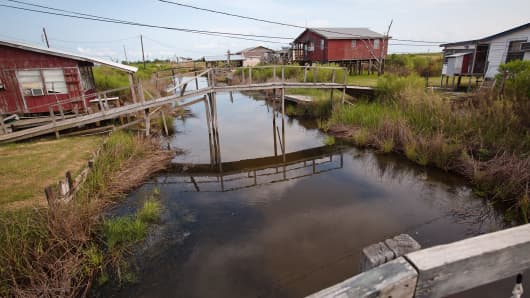
Julie Dermansky | Corbis | Getty Images
Fishing camps on Isle de Jean Charles in
Terrebonne Parish Louisiana. The Island is under constant threat of
flooding due to coastal erosion.
In the U.S., some states have already received
funding from the federal government. Last year, Louisiana received $92
million from the U.S. Department of Housing and Urban Development for
two coastal resilience-building projects.
The state earmarked $48 million
of that award to relocate 99 residents off the small island of Isle de
Jean Charles, in what will be one of the first climate-induced
relocation efforts undertaken in the U.S. Louisiana also plans to use
nearly $40 million to implement a program to shore up the state's
natural disaster preparedness and recovery strategies.
Since 1955, 98 percent of the island's mass has been swallowed up, according to HUD, with relocation efforts expected to be completed over the next few years.
Pat Forbes, executive director
of Louisiana's Office of Community Development (OCD), said there is a
lot more to the project than just getting the people off the island.
"If all we do is get the people
off the island, we have not succeeded," Forbes said. "We need them to be
a community and hopefully even build a stronger community."
Mathew Sanders, the OCD's
resilience program and policy administrator, said Louisiana is testing
out policies and frameworks that could potentially be used by other
communities across the country facing similar problems.
Louisiana, however, is just one recipient of federal aid. Other states haven't been as fortunate, at least not yet.
Philip Stoddard, the mayor of
South Miami, said he does not expect to see financial assistance from
the federal government anytime soon — even though one in eight homes in
Florida could be underwater by 2100, Zillow data states.
"In the short run . . . the
problem is almost overwhelming to the most clear-thinking of
politicians, Stoddard said, as he blasted President Donald Trump's
skepticism on climate change. Yet even still, the lingering issue of
cost looms large in the debate.
"In the long run, the entire menu of possible solutions is unaffordable," Stoddard added.
At the current time, the mayor
does not expect support from Florida, either, but said municipalities
should meet with members of the community and come up with their own
regional plans. Still, Stoddard said the problem with that approach was
that "local neighborhoods are not very good at spending money on what
they perceive as long-term problems."
Stoddard believes flood
insurance rates — which have been subsidized for years by governments —
will be the so-called tipping point for homeowners in the U.S.
When rates are allowed to rise
to a level that matches the actuarial risk of flooding, homeowners will
find they cannot afford their flood insurance and will pressure elected
officials to take action, he argued.
"Homeowners will find themselves underwater literally and figuratively," Stoddard said.
--Reuters contributed to this article.

No comments:
Post a Comment